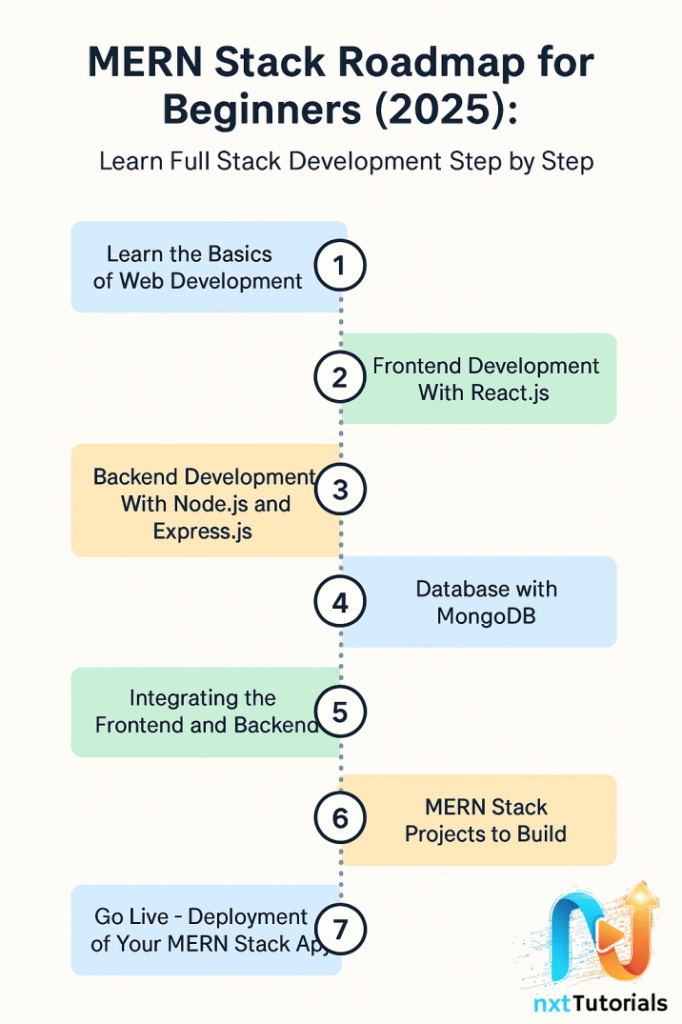
If your goal is to become a Full Stack Developer in 2025 but you’re unsure where to begin, don’t worry-you’re not alone! One of the most effective and powerful technologies to build a career in web development is by mastering the MERN Stack which enables you to build fast, secure, modern, and scalable web applications.
In this blog, you’ll walk through a step-by-step MERN Stack roadmap, starting from the core web fundamentals of HTML, CSS, and JavaScript, and progressing to frontend, backend, database, and deployment. Whether you’re just starting your coding journey as a student, fresher, and career switcher, this roadmap will help you kickstart your journey on the right path to mastering full-stack development with confidence.
🌟 Introduction: Why Learn MERN Stack in 2025?
The MERN Stack – consisting of MongoDB, Express.js, React.js, and Node.js – has emerged as a powerful and widely used full-stack framework in 2025, allowing developers to build robust, modern, and dynamic web applications. Its flexibility and versatility allow developers to work on both the frontend and backend using JavaScript, which makes it an ideal choice for you to become a full stack developer in 2025.
As of September 2025, the requirement for skilled MERN developers is skyrocketing. Companies from startups to big enterprises seeking developers who can use MERN stack for the following reasons:
- React.Js allows you to build responsive, interactive, and user-friendly interfaces.
- Node.js and Express.js power your backend framework to develop scalable APIs and server side logics.
- MongoDB offers a flexible and schema-less database to store and manage complex data.
- Unified JavaScript Stack: This stack uses single language to write code for Client side and server side which boost productivity and improve development and maintenance.
By Mastering the MERN stack in 2025, you will be ready to build complete real-world applications from scratch. You will be able to manage everything from UI design to development and deployment of final projects.
✅ Step 1: Learn the Basics of Web Development
Before diving directly into the MERN Stack technologies, it is necessary to build the strong foundation in the basic fundamentals of web development. The following three basic fundamentals will help you to learn React, Node, and MongoDB in an easier and effective way.
HTML5 – The Structure
HTML5 (HyperText Markup Language) is the backbone of your website and defines the structure/skeleton of every web page using different tags and elements.
Some of the key concepts of HTML are given here:
a. Tags and Attributes: In HTML, tags provides the structure and attributes gives the additional information about the tags. Example of tags are: <p>, <h1>, <strong>, <html> <body>, etc….
b. Semantic Elements: These elements make your code SEO friendly and more meaningful. Few semantic elements are: <header>, <footer>, <aside>, <section>, and <article>.
b. Forms, Buttons, and Inputs: Forms and Input tags like <form>, <input>, <radio> and <button> are used for user interaction and help to collect user data effectively.
c. Embedding Multimedia: HTML allows developers to add multimedia content using the <img>, <video> and <audio> tags.CSS3 – The Design
After learning HTML, mastering CSS is essential to become a Front-End developer. CSS is a short form of Cascading Style Sheet which is used to style your content on web page, while HTML defines the content on webpage. It makes your website look professional and beautiful.JavaScript(ES6+) – The Logic
Once you learn HTML for structure and CSS for styling, the next step is to learn JavaScript which adds logic, functionality, and dynamic behaviour to your website.
Here are a few key JavaScript features or concepts which are necessary to be learn before moving a head with next steps:
Core concepts: Variables, functions, loops
DOM manipulation: Update elements dynamically
Event handling: Clicks, form submissions
Modern ES6 features: Destructuring, template literals, arrow functions
Async code: Promises and async/await
✅ Step 2: Frontend Development With React.js
Once you understand the basic fundamentals of web development, the second step is to learn React.js which is the most popular and widely used JavaScript library to build dynamic, reusable, and interactive user interfaces effectively.
In 2025, React is still the top technology for frontend development due to its community support, strong ecosystem, and high demand in job market.
Essential core concepts to learn to master in React:
- Components:
In React, you can think components as the reusable building blocks of a web application. Components make your website modular, reusable, and easier to test and debug, due to which React dominates frontend development in 2025.
There are two types of components: Functional and Class components. - State and Props:
States makes your webpage dynamic, they helps to manage dynamic data of components and make the webpage interactive. Props are read-only properties which are passed between two components. - React Hooks:
In React, hooks make the functional components powerful by using the predefined hooks and custom hooks. - State Management Libraries:
React offers state management libraries like Redux and Context API to manage the data across the application like medium sized and large scale applications. - Routing with React Router:
The routing concept in react allows you to build multi-page applications like Home, Dashboard, and Profile without reloading. - API Integration:
A modern and large scale application is nothing without real-world data, so you should learn Fetch or Axios to call backend APIs. These APIs help to connect your React frontend with the NodeJs backend and third-party APIs.
✅ Step 3: Backend Development With Node.js and Express.js
Once you experienced with the frontend (React.js), the next step to learn in the MERN stack roadmap is backend development. The backend part is managed and powered by the Node.js and Express.js technolgies.
The combined code of Node.Js and Express.js allows developers to build servers, middleware-based architectures, scalable REST APIs which cazn handle multiple requests simultaneously.
Core Topics of Backend development:
- Basics of Node.js:
Node.js is an open-source JavaScript runtime framework which is built on chrome’s V8 engine. It follows an event-driven and non-blocking I/O architecture which make the website fast and scalable.Following are the basic fundamentals of Node.js which you should know for MERN stack development:
Built-in Modules: Learn built-in modules such as fs for file handling, http for creating server, and path for accessing directories.
Async Programming: Understand promises and async/await and handle the errors using try/catch block.
NPM: Learn and understand how to use, configure, and install packages available in node package manager which consists 2M packages and third-party libraries. - Express.js Essentials:
Express.js is a lightweight Node.js framework that simplifies request handling and allows developer to manage the server-side development. Express.js offers simple functions to define routes, manage middleware, and accept and return JSON response within minutes. - RESTFUL API Development:
REST APIs play a key role in the backend development which follows the CRUD operations to connect frontend with backend via GET, POST, PUT, DELETE requests.
It helps to design the endpoints and follows the best practices. It ensures that the correct HTTP status code (200, 201, 403, 500,..) is returned. - Middleware and Error Handling:
In Express.js, middleware is the heart which allows developers to validate the user inputs, add logs, and handle the errors centrally. -
Authentication and Authorization:
Security is a major concern in modern and large-scale web applications, so you have to learn the following key concepts of authorization and authentication, which protect your data from data leak and unauthorized access:- JWT (JSON Web Token): It generates token after each login maintain the session of your application and securely transmitting data between client and server.
- Encryption Technique for Password: Store user sensitive information and password using the hash password technique ‘bcrypt’.
- RBAC (Role-Based Access Control): This technique provides different roles such as Admin, Manager, and User to manage the application. It helps to control features based on the roles.
✅ Step 4: Database with MongoDB
Once you’ve learnt how to build the frontend and backend with React.js and Node.js, the next step is to understand how the data is stored and managed in the database. A powerful MERN stack application requires a reliable and scalable database – and MongoDB provides that by organising information in JSON-like documents called collections.
This database differs from traditional relational database like SQL/MySQL, which stores data in the tables in the form of rows and columns.
Core Topics to learn in MongoDB:
1. Collection & Documents: Collection is like a photo album or a table in MySQL. And, document is like a JSON object which stores data in Key-value pair.
2. CRUD Operations: MongoDB offers the following four operations which allow developers to create, delete, update, and access data in the MongoDB database.
a. Create: This operation allows you to insert the documents in the collections of MongoDB.
b. Read: It helps you to access the document from the database.
c. Update: When we want to make the changes in the database, then we have to use this operation for updating the existing key-value pairs.
d. Delete: This operation is useful when we want to remove the existing documents from the database.
3. Indexes and Queries:
As your application grows, MongoDB queries can slow down and performance become critical. To maintain application performance ,MongoDB provides indexing.
4. Mongoose:
Mongoose is an Object Data Modelling (ODM) library which acts as a bridge between your node.js backend and the mongoDB database. It allows developers to define schema for their collections and create reusable methods to make their database more structured and robust.
✅ Step 5: Integrating the Frontend and Backend
After setting up your backend and database, it’s time to connect your React frontend with the Node.js/Express.js, which is the core part of the MERN stack application. This is the step where you will connect all the three layers frontend, backend, and database and data starts transmitting between the user and the database and makes your application dynamic, functional and more interactive.
A REST API (Representational State Transfer) is the most standard and simple way to connect client with the server. It provides the following HTTP request methods to perform the operations on the database:
1. GET – Sends the GET request to the server to access data from the server.
2. POST- Sends the data from client to server to insert into the database.
3. PUT- Sends the put request to server to modifies/exchanges the existing data from the database.
4. DELETE – Sends the request to the server to removes/delete the existing data from the database on the specific condition.
✅ Step 6: MERN Stack Projects to Build
Once you have learned about the integration of frontend and backend, the next step is to start building the real-world projects. These projects not only help you understand the concepts but also strengthen profile strong and prepare for the MERN stack job interviews.
Here are some beginner to advanced MERN stack project ideas you should build:
1. To-do List Application:
This project is for beginners which allows you to add, delete, update tasks. You can understand how to perform the CRUD operations and state management using state and props.
2. Weather Application:
This is also a small application that displays live weather for a city and help you understand how to integrate third party APIs with Express.
3. Expense Tracker Application:
This application helps users to track their income and expenses. Users can add transactions, categorize them, and calculate the total balance. It helps you to understand the concept of React state management, MongoDB aggregation queries, and visualise data with simple charts.
✅ Step 7: Go Live – Deployment of Your MERN Stack App
The last and most exciting step in the MERN stack journey is the deployment of an application which transforms your real-world application into a live web application accessible to users worldwide.
Best Recommended Deployment Platforms in 2025:
1. Vercel & Netlify – Free and Fast available platforms for the deployment of frontend part of your MERN stack application. They offers automatic builds and provides free hosting for small projects.
2. Render or Railway – Beginner-friendly platforms which support node applications and provides simple cloud hosting for APIs and servers.
3. MongoDB Atlas – It is a secure platform to manage cloud-based database which is globally available with free tier.